Saturday, April 18, 2026

Liszt's Dantesque Monuments


Afterlives: Liszt's Dantesque Monuments

March 6, 2026

New College Conference on Medieval and Renaissance Studies


A complete recording of Liszt's work as performed by Cziffra can be found here


Excerpt 1 (first minute and twenty seconds of the linked recording) 

In the world of piano lessons, these first pages of Liszt’s so-called Dante Sonata are often presented as signifying the inscription, "Abandon all hope, ye who enter here."

Indeed, this music’s downward spiraling dissonances, halting rhythms, and disconcerting rumblings match Dante’s scene rather well. 

But I have questions about all this, and primarily, questions along these lines:
What was Liszt’s actual engagement with the writings of Dante, and how was that engagement expressed in and around his own work?

Key issues give rise to these questions and complicate the search for insights. Liszt scholarship continues to be involved in unravelling fact from fiction in the highly romanticized early biographies of Liszt, who, himself, famously stated to one author that his biography was “more to be invented than written.”  And in terms of challenges to discerning the creative spirit of this sonata, Liszt provided no program, no specific narrative, linking the unfolding drama of the music to anything particular in Dante. In contrast, he wrote a separate Dante Symphony in which he at least named the two movements “Inferno” and “Purgatorio” and copied some of Dante’s text above a few of the instrumental parts. A close associate of Liszt’s later provided a descriptive plan for that piece. While there is not time in this presentation to address those details, suffice it to say the origins and creation of that symphony are not as obscure as those of this sonata.  

These problems aside, we can see from a few verifiable biographical notes that Liszt’s engagement with Dante was both multifaceted and deeply personal. 

It is now thought that he had some experience with The Divine Comedy in his teens which probably amounted to reading for enjoyment or basic familiarity. But his own description of his literary interests at that time suggests he was already on a trajectory leading beyond the adulation he received as a virtuoso to a desire to enter into broader cultural conversations. 

That said, his deeper reading of Dante seems to have begun during his relationship with the Countess Marie d’Agoult. They met in Paris in 1833 and we can see from their correspondence that they read Dante together and thought of Beatrice and Dante as a model for their own relationship with Liszt being sent on his artistic pilgrimage by Marie’s qualities as a muse. They were, however, a little different from Beatrice and Dante in that Marie left her husband and daughter for Liszt in 1835 and together they had three children out of wedlock. Beginning in 1837 they spent considerable time in Italy being inspired by its history and culture but also feeling an increasing tension between the life of the family they were creating and Liszt’s touring. In the end, touring won out and in the eight years from 1839 to 1847, Liszt appeared in the areas of 21 modern countries from Ireland and Portugal in the west to Russia and Turkey in the east. 

But back in 1838, Marie mentioned in her diary that Liszt was progressing in his large-scale compositional aspirations by sketching, among other things, a “Fragment dantesque.” 

Excerpt 2 (linked recording 1:20 - 2:40)

Although Liszt never mentioned it, this second excerpt from his sonata is sometimes cast as reflecting the whirlwind of the Francesca da Rimini episode. Whatever his intention, the drama of this music resonates with the context in which he wrote the following to fellow composer Hector Berlioz in 1839: “Dante has found his pictorial expression in Orcagna and Michelangelo, and someday perhaps he will find his musical expression in the Beethoven of the future.” Here, like several of his peers, Liszt was starting to position himself as the rightful heir to Beethoven’s legacy. From his own legendary story of receiving the great master’s kiss of blessing to becoming the ground-breaking exponent of Beethoven’s esoteric late piano works, Liszt interpreted himself as a Dante to Beethoven’s Virgil.  

In the years between “Fragment dantesque” and the final version of the sonata, Liszt crossed through several provisional titles for the work. In the most thought-provoking, he described the piece as a “Paralipomènes to the Divine Comedy, a Fantaisie symphonique.” This title suggests several distinct things about his conception of the work at that point. First, being “symphonique,” it was to be no ordinary piano piece. Liszt was thinking of the orchestra while at the keyboard which makes perfect sense for him as he had also been transcribing Beethoven’s symphonies to be performed on the piano since the late 1830s. Second, in referencing The Divine Comedy, he revealed the scope of the sonata to be the entire poem, not just the Inferno, for example. Finally, and most intriguingly, the term paralipomènes, used in some traditions to refer to the biblical books of Chronicles, suggests Liszt viewed the work as something after-the-fact, an appendix or a summary. Maybe even Dantesque material presented in a different framework.

And that brings us to the final title by which the work is known today. In 1856, it was published in the Italian book of Liszt’s three-volume series of piano pieces known as Years of Pilgrimage, and there it was called “Après une Lecture du Dante - Fantasia quasi Sonata.” “Fantasia quasi sonata” is a reference to Beethoven’s innovative piano works bearing the title “Sonata quasi una fantasia.” One of these is the well-known “Moonlight Sonata” which Liszt played. The “Après une Lecture du Dante” part is the name of a poem by Victor Hugo, a reflection which summarizes a perspective on Dante’s journey that understands the journey ultimately to be life itself.  

Here is a slightly abridged translation of Hugo’s poem, “After a reading of Dante”:
When the poet paints hell, he paints his life:
His life, 
a fleeing shadow pursued by specters;
Mysterious forest where his frightened steps stray groping off the beaten paths;
Black journey obstructed by deformed encounters;                                                                       
spiral with doubtful edges, enormous depths,
whose hideous circles go ever deeper into a shadow 
where vague and living hell stirs!
This ramp is lost in the uncertain mist;
…one sees passing there with a faint sound the grinding 
of white teeth in the dark night.
There are visions, dreams, chimeras;
Eyes that pain changes into bitter springs,
Love, an entwined couple, sad, and ever burning, which in a whirlwind passes …
In a corner, vengeance and hunger, impious sisters, crouching side by side on a gnawed skull;
Then pale misery with an impoverished smile …
ambition, pride, lust, avarice … 
All the leaden cloaks with which the soul can be burdened!
Further on, cowardice, fear, betrayal …
And then, lower still, and at the very bottom of the abyss, 
The grimacing mask of suffering Hatred!

Yes, this is indeed life, O inspired poet,
And its misty path cluttered with obstacles.
But, so that nothing is lacking, on this narrow road
You always show us, standing on your right,
The genius with the calm brow, with eyes full of light,
The serene Virgil who says: Let us continue!


Excerpt 3 (linked recording 4:40 - 6:35)

In this final excerpt one might hear a return of the musical whirlwind but in lament form giving way to something more hopeful, a heavenly and noble continuation.

To conclude, having outlined some of Liszt’s multi-faceted and personal ways of processing Dante, it seems reasonable to assert that this sonata does not retell The Divine Comedy so much in any specific way as it invites the listener into reflecting on their own knowledge of Dante. Its narrativity is of a general sort, harrowing and soothing the listener by turns with clangorous sonorities and other-worldly harmonies, all to stir up a remembrance of their own experiences of Dantesque materials. 

Liszt was adamant regarding the crucial role of individual engagement in the experience of music. When he heard pianists perform with little imagination, he accused them of what he called “the Pilate offence” of washing their hands of interpretive responsibility. If he showed up here today, he would likely hold us to a similar standard as listeners. Perhaps he would call the Sonata, “Having read Dante . . .” and would follow it up with a good conversation with each of us about our own insights.  


Sunday, September 21, 2025

O Crux, Ave


O Crux, Ave: A Piano Recital for the Feast of the Holy Cross

All Saints' Episcopal Church Performing Arts Series 

September 21, 2025

Spoken program notes


I am going to talk a bit about the pieces I am playing, but first I would like to share why I am playing them. 


Many Christians celebrate a Feast of the Cross around the middle of September. It is a time to consider that, over the centuries, the Church has found there is something to be gained by engaging the Cross with the imagination. 

In that spirit, Christians have looked for the true cross, built churches in its shape, and dedicated them to its honor. We have developed practices of venerating its image and of commemorating the path Jesus took to his crucifixion. And in our worship, we use the gesture of the cross to bless ourselves and others, to sanctify baptismal waters, and to consecrate bread and wine as our Eucharist. 

This afternoon’s recital is a meditation on such spiritual traditions.


1. Legend: St. Columba Rebukes the Beast of Ness

Based on the Irish tune COLUMBA, my Columban Legend unfolds the story of the saint’s confrontation with the beast of the River Ness. Making the sign of the cross, signified in the music by a brief passage of expanding and contracting intervals, Columba sends one of his monks into the water to retrieve a boat. On sensing the monk’s presence, the beast rises to the surface and rushes at him with the intention of devouring him but is rebuked by the saint who, once again, makes the sign of the cross, reversing the monster’s motion. The legend concludes with a song of praise sung by the bystanders who have witnessed this demonstration of God’s power. 


2. Prelude in F Sharp Minor, WTC II by J. S. Bach

Hear these words from a 10th century Irish prayer.


Christ’s cross over this face, over this ear, over this eye . . .

Christ’s cross to accompany before me, to accompany behind me. 

Christ’s cross to meet every difficulty both on hollow and hill. 

Christ’s cross eastwards facing me. Christ’s cross back towards the sunset. 

In the north, in the south, increasingly may Christ’s cross straightway be. 

Christ’s cross up to broad Heaven. Christ’s cross down to earth. 

Let no evil or hurt come to my body or my soul . . .

Christ’s cross be all my strength until we reach the King of Heaven. 

From the top of my head to the nail of my foot, O Christ,      
against every danger, I trust in the protection of the cross.                                                                    

Till the day of my death, going into this clay, I shall draw without: 

Christ’s cross over this face. Christ’s cross over me as I lie.


3. from Via Crucis by Franz Liszt

Liszt envisioned his Via Crucis for use during the annual devotion of the Stations of the Cross in the Roman Colosseum.  In the introduction to this work, Liszt evokes that liturgical remembrance of Jesus’ journey by quoting the ancient hymn “O crux ave” and writing in musical styles of pipe organ and choir. In the second selection, Liszt depicts the eye-to-eye encounter of mother and son along the Via Dolorosa with a starker texture and a melody that winds its way from the agonizing to the sublime. In the final selection, Liszt returns to richer musical resources but adds an accompaniment like a faltering heartbeat ultimately leading to a series of haunting harmonies that mark the strange scene of the Lord’s lifeless body being taken down from the cross and laid in the tomb. 


4. Two-Part Invention in E Major by J. S. Bach

One of the great exemplars of artists who consecrate their genius to God, Bach wrote works permeated by Christian symbolism. 

As the midpoint of this recital, his Invention in E Major can be heard as an elegant sonic projection of cross-like geometry. In virtually every measure of this music, one musical line rises while another falls, creating a sense of many mirror images and intersections. 

While listening, one might also be reminded of Jacob’s Ladder interpreted as a type of the Cross where heaven and earth meet.


5. from Bagatelles, Op. 119 by Beethoven 

Andante con moto, a l'Allemande, and Andante cantabile

Whether channeled through the form of a large symphony or a tiny vignette, the elemental passion of Beethoven’s voice never fails to come through. That quality in these three bagatelles is a life-affirming answer to the somber nature of Liszt’s Via Crucis pieces. 

Beethoven has the hands of the pianist crossing playfully for much of the first piece, leaping from register to register in the second, and finally gliding with a gentle joy in the third. 


6. Fugue in F Sharp Minor by Bach

From “The Dream of the Rood” portions of which existed as early as the 8th century being carved on the Ruthwell Cross - 

Its unknown poet writes:


I beheld in sorrow the Savior’s tree until I heard it utter a sound;

that best of woods began to speak words: 

“It was so long ago––I remember it still––

that I was felled from the forest’s edge, ripped up from my roots. 

Strong enemies seized me there,

made me their spectacle, made me bear their criminals;

they bore me on their shoulders and then set me on a hill,

enemies enough fixed me fast. 

Then I saw the Lord of mankind hasten eagerly, 

when he wanted to ascend upon me.

I did not dare to break or bow down against the Lord’s word,

when I saw the ends of the earth tremble. 

Easily I might have felled all those enemies, and yet I stood fast.

Then the young hero made ready—that was God almighty—

strong and resolute; he ascended on the high gallows,

brave in the sight of many, when he wanted to ransom mankind. 

I trembled when he embraced me, but I dared not bow to the ground, 

or fall to the earth’s corners––I had to stand fast.

I was reared as a cross: I raised up the mighty King, the Lord of heaven; 

I dared not lie down.


7. Legend: St. Francis Blesses the Birds

Liszt’s Franciscan Legend paints the picture of Francis preaching to the birds that they should be grateful for God’s provision as should his brothers who are looking on the scene. Liszt masterfully conjures the sounds of birds as well as the speech of the saint all in an atmosphere of sacredness. The phrases of the saint’s sermon have a cross-like contour, rising and encircling a particular pitch. The legend concludes with Francis’s benediction spoken over the birds as he makes the sign of the cross and they fly aloft, disappearing into the brightness of the sky.   


Sunday, August 31, 2025

Action After Pilgrimage


Today is St. Aiden's Day. Three months ago tomorrow, our group arrived on Lindisfarne. It seems like a good time to share this reflection on action.


The sense of ultimacy generated by a good pilgrimage can draw us into the joy of feeling really alive back home in our own communities. Such a completed journey serves as an invitation to a greater awareness of our own spiritual unfolding, and we continue onward with fresh views of God’s presence and provision. 


To some extent. 


For a while.


But then what?


There are some paths to pursue from there, paths illuminated by the radiance of those pilgrimage experiences. 


To get started, we need not be in a hurry to let our pilgrimage go. Medieval pilgrimages to Jerusalem, Rome, or St. David’s would have taken a more sustained effort than ours, and that effort would have shaped pilgrims in ways that profoundly affected the whole person. Those journeys were a matter of months, not weeks, and we would do well to adopt a similar pace in processing ours if we are truly to be transformed by it.  


As we take that time, we can consider our personal individual paths first. Many pilgrims carry specific questions on their journeys, and those questions can lead to new practices, as well as to the enrichment of familiar practices, back home. If being pilgrims has stirred our creativity, that newness and enrichment might also guide us in making something new. Further, the clarified perspective that sometimes comes with pilgrimage can open us to the discernment, calling, and courage we need for whatever our next steps might be. 


Beyond ourselves, we have opportunities to keep the discussions of pilgrim days going. Many times, such journeys provide new topics and new partners with whom to consider them. In choosing to continue those conversations, we foster a greater fullness in relationships both old and new. But if that feels like too much, we can at least connect with our fellow pilgrims sometimes in passing over shared memories of moving experiences that are now common points of reference. 


As our view broadens over the weeks and months, we should look for our understandings of our time away to shift and settle. The things that impressed us most while we were traveling might turn out not to be so significant, and we might even be amazed to discover that our least favorite aspects were carrying the most important messages for us.


Past all of this, we will go through times when it seems like the inspiration of our pilgrimage has run out and our worlds have become inundated by the humdrum. I believe those are the very moments we most need to stay true to the fruits of Spirit that were so sweet on our journey and to adopt an outlook that sees all of life as a pilgrimage. 


Thursday, August 07, 2025

Thoughts After Pilgrimage


To go on pilgrimage is to engage a vision of God. It is a mystical striving to see ourselves traveling from/to/for/with/about the transcendent. 

But what do we make of such experiences once we return to our everyday lives?

As a journey takes time, pilgrimage invites us to consider various modes for processing time. Pilgrimage is a sustained engagement with sacred time, but it is not the only way of functioning in that mode. Regular participation in corporate worship is the most familiar way, and in our sabbaths, we pause something of our mundane concerns and return to the metanarrative of our tradition. Retreat is another way of infusing our perception of time with a sense of sacredness and is often defined by an intentional quieting to listen for "the heartbeat of God." Pilgrimage is distinct from worship and retreat as it typically incorporates physical travel to move us spiritually. 

As we do that traveling with others, we become mindful of the uniqueness of each pilgrim receiving the divine through their own spirituality and history. We understand our shared journey in ways distinct to our own conditioning while our understandings of ourselves are challenged by traveling together.

As we return from pilgrimage, we have many stories to tell, and we go through a process with those stories that is as old as inspiration itself. We are fortunate to have lived the very context of the stories. We were present for all the details, and pilgrimage provides the added benefit of being able to compare our memories with those of fellow pilgrims. Beyond those rich resources of first-hand knowledge, we provide interpretation as we tell our stories. We know what was most meaningful to us and we continue to track that meaning as it develops in our spirits. Finally, we have opportunities to apply that meaningfulness. As we pursue those opportunities, we find ourselves following the dictum of Father Gildas of Caldey Abbey: "What matters most is what we individually make" of the ways God has come to us. 

What forms might that making take in the weeks and months following a pilgrimage? 

Sensitive consideration is needed to answer this question. This is due in no small part to the reality that the thin places visited on such a journey are famously "homes for pilgrims" meaning people of a pilgrim orientation find a welcoming freshness in them. Not everyone resonates with this phenomenon, and its great purity can seem impossibly far from our everyday lives. So it is that our usual settings are the places most in need of the perspectives of pilgrims. 

Perhaps our best hope going forward is to patiently seek a gentle integration of the gifts of those wonderful times wherever we find ourselves. To do so, we might need to navigate undercurrents of disappointment or even despair. Maybe we have failed to follow through on possibilities of a new way of life we glimpsed on pilgrimage, but the effects of our journey are still within us. Such holy stirrings survive whether we nourish or neglect them, and often, it simply takes more time than we imagine to discover all that these urgings might become. 

Wednesday, June 11, 2025

A Pilgrim Tour

The following is a little tour of Durham Cathedral I gave our group of pilgrims. The purpose was to get oriented in this tremendous space so that each participant might form a clear idea of how they wanted to spend the limited free time they had there. (We had driven from Lindisfarne and needed to beat the tides coming and going, so we were on a bit of a schedule!) 

Perhaps this post can serve as a meditation whether or not readers are able to visit Durham.  


1. Arrival, Cloister, and Ambulatory

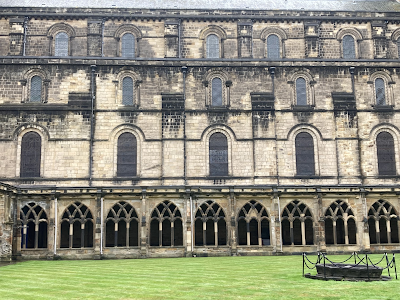
These are pilgrim spaces created to provide shelter and access for others who, like us, traveled from afar to the Cathedral in a sense of devotion. 

Drawn into the spirit of Cuthbert, we prayerfully gather in awe and anticipation.


2. The Space Itself

From the outside: Romanesque, rounded, a massive fortification - the most monumental Norman edifice we know. 

Inside, "as big as all outdoors" - towering, sturdy, its pillars like a grove for giants. 

There is a sensation of being outside even though we are inside, a feeling that some land and air deemed sacred have been enclosed with a sublime grandeur of reverence. Indeed, signs of nature surround us, not only in the natural building materials of wood and stone but also in the fossils that fill the locally-sourced Frosterley Marble.


3. The Tomb of Bede in the Galilee Chapel

Above the tomb of this saint and historian we find his beautiful prayer:


Christ is the morning star, who,

when the night of this world is past, 

brings to his saints the promise of the light of life 

and everlasting day. 


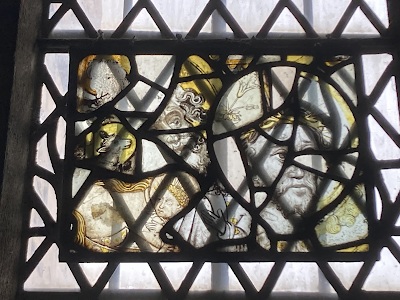
This area is airy and bright, and the windows through which the light reaches us incorporate hundreds of fragments of older windows giving a lovely sense of new life to what was broken. This befits the intellect and writings of Bede and is an inspiring image of how we might meaningfully arrange what sometimes seem to be disjointed beliefs, experiences, and parts of our lives. 


4. Cuthbert's Window

While the Cathedral is unmistakably old and remarkably preserved in its singular style (except for the "new" Gothic part), it has room for the modern which somehow gives it a distinct quality without upsetting the impression of consistency. There is a balance - or better yet, a cooperation - of deep, deep roots providing a platform for the flowering of fresh branches. 

This, too, can be a model for our lives as we build on the ancient insights of a historic faith manifested anew in our own lives.


5. The Clock

This artifact reminds us that, despite its spiritual import, this cathedral was, itself, an assertion of political presence and served as a makeshift prison. 

After the 1650 Battle of Dunbar, as many as 3000 Scots were imprisoned here with well over 1000 of them perishing within its walls. 

During that time, the clock was untouched while virtually every other wooden thing was burned for warmth. Why was it spared? According to legend, it was passed over due to the emblem of a thistle in its design, a key symbol in Scottish heraldry. 

Standing in the transept and pondering this story, we are reminded of the embattled world the Church inhabits even today. 


6. The Shrine of Saint Cuthbert

In my experience, this space induces an attitude of humility. 

Perhaps it is the magnitude of Cuthbert's devotion reflected in the present-day simplicity of the room. 

Or maybe it is the striking tester above the tomb and the touching statue of Cuthbert holding King Oswald's head. 

Beyond that, there is a resonance of the prayer rail with that of the rock in Jerusalem's Garden of Gethsemane Church of All Nations. 

As the Spirit weaves these together, our impulse is worshipful silence.


7. Chapel of the Nine Altars

Unfortunately, this area was closed during our visit, but we could still see into much of its space, a space of inspiration and imagination.  

Here is demonstrated something of how beauty can serve as a portal to heavenly things. In the richness of its symbols and references, its constellation of altars projects a vision of God through the lives of saints such as Margaret, Hilda, and Aiden, not to mention the soulful Pietà of Fenwick Lawson whose The Journey we had seen in St. Mary's back on Lindisfarne. 


In this city famous . . .
a river strong of wave . . .
in the deep dales deer innumerable


well-known among her sons:

the blessed Cuthbert . . .
the head of the pure king, Oswald . . .
the famous scholar Bede . . .


There dwells among the blessed in that minster 
also relics uncountable,
where many are worthied, 
just as the Book says to do —

in their company a man of God can await his glory.


- excerpts from an Anglo-Saxon poem translated by Dr. Ophelia Hostetter


Monday, May 05, 2025

A Follow-up with Pilgrim Friends


Dear Friends,

Soon we will be traveling together so I wanted to share a few thoughts about preparing and going.


We have considered that a pilgrimage is a journey undertaken with devotion, and that means one is already on pilgrimage from the moment they consider going on such a journey. 


Since this is the case, it is helpful to prepare in a devotional fashion. 

Not like a tourist. Not to study and process every detail of history or geography. Not to have in hand every aspect of the planning. 

But instead, to prepare our hearts. 


To orient in this way, I suggest starting to prayerfully ask the following:


What do I need?


What hurts need healing?


What questions need answering?


What might I take and what might I leave both at home and along the way?


How will I open to the sites of saints' lives?


How will I look for what the land might convey in terms of beauty, spirit, heritage?


Will I travel for someone else, someone who could not take such a journey?


What will my personal spiritual practice be?


What will my creative inlet be? (Often we speak of creative outlets, but our creative activities can be a means for the Divine to reach into us, too.)


And how will I engage hospitality at every point - to fellow pilgrims, to Christ in the stranger, and even to myself?


Saturday, January 04, 2025

A Little Letter to Pilgrims

Later this year, Kathy and I will be supporting several groups of retreatants in experiences of pilgrimage. These thoughts were initially written with those retreatants in mind but I share them here for anyone who wants to consider how the spiritual life in the Christian tradition is shaped like a pilgrimage. 


My dear fellow pilgrims, 


Pilgrimage is the metaphor for the spiritual life (and for life in general) with which I resonate most fully.


Since the beginning, pilgrimage has been an element of the Christian experience whether that involved walking the Holy Land, dreaming up our own Bethlehems and Jerusalems, or going on the great spiritual odyssey of the soul with its maker. 


For the purposes of this little letter, my definition of pilgrimage is 

traveling with God to God.


At Epiphany, I think of the first pilgrims: the magi.

They saw signs of the divine and followed to the house of the young king Jesus.


But really, the shepherds came first from a field nearby and were put on their path by holy angels who had, themselves, traveled from Heaven to proclaim the good news. 


And before the magi and the shepherds and those angels, there were Mary and Joseph who travelled most literally with God to meet the Messiah in Bethlehem.


And before that journey, Mary made her way to Elizabeth, and was, herself, the sacred space in which God was reconciling the world to himself.   


And before that, Gabriel came to her.


And before that, 

and before that, 

and before that . . .


Abraham was called by God to travel with him and to him. 

(That's the beginning of the genealogy in the Gospel According to Matthew)


And even before that, Adam.

(That's the beginning of the genealogy in the Gospel According to Luke.)


Adam was already in the place of encounter with God. 

But something happened and their communion was broken. 

Barred from the Garden, Adam wandered into the world, without God, in a sense, and always at least a little bit away from God. Adam's path had became an anti-pilgrimage.


So all our pilgrimages involve a turning, indeed a re-turning: a turning back to travel with God and to God, a movement toward sacred spaces of encounter and communion.  


It is a blessing to know that, even with our first steps on the road of pilgrimage, we are already on the re-turn trip!