Thursday, January 21, 2016

Silence, Music, and Deep Prayer 3

Last night, we continued our consideration of prayerful music with a discussion of the Psalms.


From Bonhoeffer's helpful little book Psalms: The Prayer Book of the Bible:

The disciples asked Jesus how to pray. It's frustrating to feel that you don't know how to pray, to feel that somehow your prayers aren't making it to God. In response, Jesus gave them the Lord's Prayer.

The book of Psalms is a book of prayers which is a little odd given that we tend to think of the Bible as the word of God while prayers are thought to be the words of humanity to God. How can this be? Somehow, Jesus prays in the Psalms. As we pray them, the words of God become our words.

In the tradition of Luther, Bonhoeffer asserts that "All the prayers of Holy Scripture are summarized in the Lord's Prayer, and are contained in its immeasurable breadth." The Psalter and Lord's Prayer interpenetrate and are understood through each other. "Thus the Lord's Prayer becomes the touchstone for whether we pray in the name of Jesus Christ . . ."

With my students at Southeastern, I discuss that we Christian musicians and artists are psalmists.

By this I mean that we process life through our creative work with a mindfulness that we live and create in God's presence. This is what the writers of the Psalter did. They honestly expressed their struggles and joys but always did so with an eye to their relationship with God.

At times, we struggle with weariness, emotional turmoil and confusion. Prayerful music helps to orient us so as to be able to lift those things to God and to open ourselves to the Spirit's touch. We repetitively sang this brief new setting as a possible experience of these dynamics. We concluded our singing with a gradual diminuendo enacted by each singer ending his or her singing when ready to do so. This was a lovely way to enter into silence and a reification of John the Baptist's words, "He must increase, but I must decrease."


Following this experience, Dr. Larry Sledge (All Saints' Music Director) shared insight into All Saints' rich tradition of Psalm-singing based on his own numerous settings of Psalms. He highlighted the following topics among others.

The 1980s as "the decade of the hymnal" -
many denominations were publishing new hymnals and often including significant sections of singable Psalms

Exhortations in the Psalms themselves to sing to the Lord with a new song

Incorporation of expressive melodic notes and surprising harmonies to give a sense of newness

Invitations within the Psalms to praise but also to seek God in quietess at times
 
Use of melodic shape and text-painting to clearly indicate the priorities of the text and to add meaning to the singing so that the Psalms can be "brought to life" in such a way "that the congregation can take part in them" 

Use of various translations to refresh the singers' engagement with very familiar passages

Choice of texts for congregational refrains to provide a central message to the singing of particular Psalms

We concluded the evening with a worshipful compline service with liturgy adapted by Dr. Cotton and Dr. Sledge's beautifully harmonized, chant-like setting of the Lord's Prayer.

Writing this post on the following morning, I share this recording of the Lakeland Choral Society singing a Tallis Psalm-setting under Dr. Sledge's direction.


Wednesday, January 13, 2016

Silence, Music, and Deep Prayer 2

A capital in the cloister of Iona Abbey
Dr. Cotton introduced this evening's class with some quotations from the keynote sermon he delivered at the 2014 Lasker Summer Music Festival. The full text of that sermon can be read here.


Very Brief Historical Background of “prayerful music”

Music in First century Christian worship -

rooted in Jewish musical traditions

Scripture indicates “psalms, hymns, and spiritual songs”

From the 300s -

St. Basil the Great celebrated the role of music in teaching and spiritual formation noting that while we chant, we become “trained in the soul.”

St. John Chrysostom warned of the use of instruments because of their association with the “shameful words and songs, and drunkenness, and revellings, and all the Devil’s great heap of garbage” associated with wild wedding parties.

Pro and con, we consider similar issues today.

And around 400 -

A nun name Egeria visited Jerusalem and witnessed Christian worship that included the use of incense, the singing of psalms – possible sung antiphonally – a procession with the reading of the gospel, prayers, hymns, preaching, celebration of the Eucharist, an elaborate time of dismissal in which congregants interacted individually with the bishop. She also observed wailing after the scripture reading at the Easter Vigil, and a great deal of preaching

This sounds quite Episcopal/Catholic. Perhaps also evangelical and Pentecostal!

(These excerpts and many other relevant things can be found in Weiss and Taruskin’s anthology, Music in the Western World)

Around 600 -

Pope Gregory the Great 

traditionally credited with the reformation of liturgy and collection of chant leading to there being a body of worship music known as “Gregorian Chant.”

In the 800s, a legend developed attributing the corpus of chant to Gregory to whom it was dictated by the Holy Spirit in the form of a dove.

Charlemagne (742-814) probably had a lot to do with the actual collection of chant and codification of worship as that was a part of his program for a more cohesive empire.

Chanting
Quotations from writings of Dom Joseph Gajard in the 1930s

Gajard was Choir-Master of the Solesmes School which had reinvigorated chanting in the 1800s. 

“[Chant] is above all a prayer, better still, the prayer of the Catholic Church, which here attains its full expression. It is, therefore, something pertaining to the soul and stands on a higher plane, like the entire liturgy, of which it forms a part and from which it cannot be separated. It is a form of spirituality, a way of reaching up to God and of leading souls to God. . .”

“Gregorian chant . . . is primarily a matter of prayer, and by it we are raised at once to the consideration of things on the supernatural plane . . . The chat cannot be sung well without prayer, neither can we pray without singing well too.”

“Rhythm is a question . . . of movement . . . It is a grouping of sounds into a synthesis . . . its work is to withdraw each sound from its pure individuality and blend it into one large movement.

How to Chant?

Consider this idea of movement.

To some extent, this movement is derived from the text as there typically is no musical meter to chant in the way we think of meter today.

How would you read the text?

Once those key words and syllables are determined, how do we move between them?

I suggest that we consider the movement of a bird moving from branch to branch and order our chanting accordingly.

This interpreting of musical gestures (and the resultant performance) is an matter of reification. To reify is to give something abstract a more concrete expression. The creation of objects, including musical "objects" such as compositions or performances are reifications of ideas and spiritual "movements." Processes of reification play an important role in our spirituality and formation.

In this activity we reify the movement of birds symbolizing the Holy Spirit.
"The Spirit is like a bird, fragile alloy of heaven and earth, where wind and feather and flight meets breath and blood and bones. The rabbis imagined . . . a pigeon, the Celts a wild goose. Like a dove, the Spirit glided over the primordial waters, hovered above Mary’s womb, and descended onto Jesus’ dripping wet head . . . The Spirit is as common as a cooing pigeon and transcendent as a high-flying eagle. So look up and sing back, catch the light of God in a diaphanous scrim of wing. Pay attention."
- beautiful words of Rachel Held Evans in Seeking Sunday
  • Sing opening verse of Veni Spiritus Creator together.  
Click here for a rendering of the chant in Latin with numerous images of art depicting Pentecost.

Anglican Chant

By the 1500s, what has come to us as the tradition of Anglican Chant was developing.

Anglican chanting is usually accompanied by a series of ten chords repeated for each verse.
  • Practice the Nunc Dimittis or Song of Simeon in Anglican Chant form. It is incorporated into Compline and Evensong as, in the twilight of his life, Simeon saw the baby Jesus, and then could rest. It is often followed by the Gloria Patri. 
Click here for a lovely recording of one Anglican chant version of the Song of Simeon. 

Wednesday, January 06, 2016

Silence, Music, and Deep Prayer 1

 
Starting this Wednesday and continuing on 
Wednesday nights until the week after Easter, 
my friend and colleague, Dr. Rickey Cotton, 
and I will be teaching a course in the parish 
academy of All Saints’ EpiscopalChurch here 
in Lakeland. 


The course is titled Practicing Intimacy with God II: Silence, Music, and Deep Prayer. Over its twelve weeks, Dr. Cotton will share studies and practices of contemplative prayer in the Christian tradition and I will present some teaching and musical activities involving what we are calling “prayerful music.” 

As a discipline for myself and as a possible resource for others, I will be sharing lesson plans here. 


January 6 – Introduction and Overview


Early in the class, 
we will have a taste of what we mean by “prayerful music."

  • Sing together an example from Taize: “Come and Fill." 
This is simple - easy tune and brief text.
There is nothing in its design to distract us from our devotional experience. 

And it's repetitive.
The hope is that, over time, these words truly become our own prayer.

Or, as it says in the introduction to Songs and Prayers of Taize -
" A few words sung over and over again reinforce the meditative quality of the prayer. They express a basic reality that can quickly be grasped by the intellect, and that gradually penetrates the heart and the whole being."

Click here for a lovely recording of "Come and Fill" in Latin along with beautiful shepherd images.  

An introduction to the class from my perspective

My goals are to support the on-going development of spirituality and community.

In other words, I want to contribute to the nurturing of your souls and mine, and to deepen our knowledge and connection regarding one another.    

My approach to doing those things will involve activities that might enrich our engagement with pieces of music. Participation in those activities is voluntary and I realize participation might sometimes take us out of our comfort zones. While I am a professional musician, I am specifically a pianist and a professor. In this class, however, I will need to do a lot of singing. This makes me feel very vulnerable but I am trusting that such vulnerability - mine and yours - will support the goals of the endeavor.

Why consider music in the development of spirituality and community? Because music integrates and coordinates aspects of ourselves in ways that are unique and profound. 

One example: neurologists have found that memories - and therefore a sense of identity and faith experience - can be embedded in musical experiences long after language skills and a sense of personal biography have significantly deteriorated. If we are seeking to "be transformed by the renewing of our minds" - if we are looking to radically change the way we understand ourselves and others - then it seems we would need to take music into consideration.    

Click here to see renowned neurologist Oliver Sachs speaking eloquently about the responses of Alzheimer's patients to music. 

What is the relationship of music to the pursuit of silence or silent prayer, and how does it fit into this course?

I contend that music can be engaged in as a spiritual discipline along the lines of Henri Nouwen's definition as quoted in Spiritual Direction, "Almost anything that regularly asks us to slow down and order our time, desires, and thoughts to counteract selfishness, impulsiveness, or hurried fogginess of mind can be a spiritual discipline."

To discuss the question more specifically,
 
1. Music happens on a canvas of silence and incorporates silence. (We call those internal silences "rests" which is sometimes how they function.)

2. Silences around and within music create opportunities for us to develop a sense of the other. For example, we pause to breathe after a musical phrase and we remember that first breath with which God animated our race and continues to preserve it.

3. Music moves us in the direction of silence as it focuses us and helps us begin to quiet the noise of our own thoughts as we align together with its processes.

What to expect in this course?

1. An overarching musical concept each evening that might enrich our musical experiences in corporate worship, private worship, and maybe even in the concert hall

2. Experiences of various forms of music and services of worship including Taize, chant, spirituals, compline, world hymnody

3. Guests such as Ed Bryant, Larry Sledge, composer friends, students

Journey

The overarching theme for the musical aspects of this evening's class is the "journey."

It's a familiar contemporary proverb: "It's all about the journey."

But it's also an enduring truth. The pilgrims of Canterbury Tales had some transformational opportunities as they shared stories on the way to the shrine of Becket. And the first disciples responded to Jesus' invitation, "Follow me," whivh immediately put them on a journey with Jesus.

We are sharing a bit of trail as we spend these twelve Wednesday evenings together and we are sharing an even lengthier portion of our journeys during our time in Lakeland and at All Saints. 

But our individual journeys reach back before we were all here together.
  • Take a few moments to share with those around you where you came from - denominationally, geographically, etc. You might also consider sharing something you have left behind as being on journey involves leaving as we move forward.  
In the next ten or fifteen minutes, we will be engaging with a hymn about journeying, and we will do so through several activities that highlight different aspects of the experience of this hymn. For those familiar with the practice of levio divina, this process will be similar in the way it deepens our experience by considering the work from various perspectives.

Let's begin by generally noting that a musical work is itself a little journey. Much like the accelerated living of travel, a piece of music moves us rather quickly through the shape of a possible life, of a journey with beginning, middle, and end. The beginning, or introduction, frequently gives us some hints about the terrain to be traversed. The ending often involves a broadening or, at church, an "Amen" with which we affirm the conclusion of that particular journey.

The tune to which we will be singing tonight is BEACH SPRING attributed to Benjamin Franklin White. It is a folksy, pentatonic tune that appeared first in 1844 in The Sacred Harp which White edited. Its name comes from a baptist church near where he lived in Georgia. 

Much of the music in the Old Testament appears to be accompanying travel - processions at coronations, movements of troops, the entrance of pilgrims into Jerusalem. The music of the church continues to be mostly at a walking pace.
  • Let's walk to this tune and discover what sort of walking it inspires. This is a procedure for getting a general idea of its character from its pulse and meter.
This tune suggests a vigorous sort of walking, a lilting quality, with moments that require extra energy - much like one's gait moving along a path of pilgrimage.
  • As we listen to the tune, let's trace the shape of the melody in the air. This will give us a more detailed sense of its terrain. 
In its first two phrases it moves up and down little hills. And the terrain is identical in those two phrases. Then, in the third phrase, there's a rapid rise to a higher plane and through a more jagged pass. In the fourth phrase, it climbs back down and comes to rest in a similar place to where it started.  
  • Let's look at Richard Gillard's text known as "The Servant Song" which comes from the 1970s. Gillard lives in New Zealand and is a self-taught guitarist in a folk style.
Verse 1 

We sing this hymn as an invitation and an exhortation to each other. 

This verse emphasizes that we do not journey alone and that we need to be attentive enough to each other that we might provide the right help at the time when it is needed.
  • As we sing this verse, you might want to lift your hand as if you are holding a lantern for someone else to see, or you might extend your hand to a neighbor across the table.
Verse 2 

This verse puts identical words in the mouths of men and women and pinpoints the reciprocal nature of Christian service. We need to give and receive service.   
  • As we sing this verse, gentlemen please sing the first two lines to the ladies and ladies respond with the last two lines.
Verse 3

This last verse expresses the truth that the journey of life involves joys and sorrows, laughter and tears, regardless of our religious beliefs. And we are reminded that Christ's way was one of agony. He journeys with us. 
   
Click here for "The Servant Song" sung to Gillard's own tune.

Compline

This evening we will sing a two-measure setting of words from the first verse of Psalm 4 composed for the occasion.

Our Compline hymn-activity will be Francis Patrick O'Brien's "Epiphany Carol" which can be sung to the BEACH SPRING tune.

This carol is particularly well suited to the occasion as

1. Today is Epiphany.

2. The Magi were on a journey.

3. The text incorporates images of night and day, light and darkness.
  • While the text is read, hum BEACH SPRING as if it were a lullaby to the toddler Jesus.


Tuesday, December 22, 2015

Coda

So often in life, there's some extra bit that needs to be done after you thought the project was completed.

Hence, the coda.

Saturday, December 05, 2015

Christmas Concert - Worship on a Grand Scale

I am sharing the following at the opening of this season's SEU Christmas concerts.

As you might have seen on our schedule of arts events or gathered from our Facebook posts, this concert is about “worship on a grand scale.” In the next two hours you will hear the voices and the instruments of our department united in musical prayers and in the proclamation of the coming of Christ. In addition to those sacred expressions, you will also hear themes from famous movies and ballets, as well as romantic songs of the season. While it is occasionally our impulse to criticize these more secular expressions for missing the reason for the season, I invite you to hear them differently tonight. I invite you to engage with them not so much as entertainment but as signs of the coming of Christ out beyond the walls of the church. I invite you to receive them as the vibrations in human culture of the reality of Jesus becoming one of us 2000 years ago. For when we sing of sleigh rides in winter wonderlands I think we reveal humanity’s longing for a path of joy and peace; and when sugarplum fairies dance in our heads and across our stages we begin to open our hearts just a little bit to the possibility of the truly extraordinary. When we celebrate the giving of gifts and the warmth of home, we echo the miraculous provision of that first family of Christmas in Bethlehem. And when Santa flashes across the big screen - the grandest forum in American life - we remember that, as songwriter Kyle Matthews puts it, “Everything Santa knows, he learned from Jesus like how the finest gifts we give, we give in secret  - like sneaking in on Christmas Eve in ways we’d never dream, putting little children first. Everything Santa knows, he learned from Jesus long ago.”

Click here for Kyle's full song and a very nice fan video.

Saturday, November 28, 2015

Community

As a friend pointed out, if you talk about authentic community a lot, you might not be having much of it. (This is probably true of a lot of things like integrity, transparency, etc.)

Or, to paraphrase Picasso, once a culture starts to have a concept of "art," the dis-integration process is well underway.

In other words, when all these good things are functioning well, they are likely to go unnoticed.


I'm in the midst of a very busy week or two. I share the following partly just to keep a little record for myself.

Tuesday night, I accompanied some musical theater and played a Chopin nocturne for a Polk County Museum of Art event at the Lakeland Yacht Club. That was an elegant affair on the shores of Lake Hollingsworth. It was special for me to play such a wavy night piece for that occasion and at that location.

On Thursday, my new art colleague, Jon Seals, and I presented a collaborative effort for Southeastern's weekly "Reflection" chapel service. This involved a meditative piece I wrote when my father was dying, some slow-motion footage of the ocean that Jon provided, and a reading of this poem by R.S. Thomas.

Tomorrow, I'm providing a masterclass for our local Music Teachers Association students. The next morning I'm accompanying the All Saints youth choir for the First Holy Communion service followed by accompanying a number of SEU vocal students at our Afternoon Melody concert at the museum. And Monday, I'm the guest pianist for a gospel anthem on the SEU Choral concert.

None of the works I'm performing are super challenging to play, so I'm enjoying all these opportunities to be musical with others without having to put in a great deal of a time in the practice room. And that brings me to the topic of this post - sharing a number of points relevant to making music in community.

1. I approached preparing the nocturne performance as a test. I've known the piece for a long time and I wanted to explore the effectiveness of a series of procedures for bringing the work back up to a performing level over the course of the few days available. I won't outline the process here, but I am glad to be able to indicate that it was pretty effective.

What wasn't effective was this: I spend most of my piano time teaching others which means I develop a vision for their playing, but not so much of a vision for my own. When I do practice, I experiment a lot, and I frequently experiment while I'm performing. That might have worked for me for a while, but I am starting to recognize another path.

Experiment, absolutely, and do so in practicing a lot, but keep the performances focused on fundamentals. Those who know me might not think that sounds like me, but I have recognized for some time that those of us who have a more expressive and imaginative bent need to put energy into fundamental musicianship while those who are more basic in their approach need to actively pursue a more creative tact. The first sort of pianist needs to aim at a simple and stable approach while the second needs to seek inspiration and to develop s sense of spontaneity. The goal for both is better communication with the audience which is why this has something to do with community.

2. Working in the context of an artistic community is really key to getting something of quality done. In my immediate community, there are three poets, two composers, and a painter. I usually find conversation with colleagues from other disciplines to be the most fruitful but talking about the composing process with other composers is also always a wholesome and helpful way to spend time. What I particularly value about interaction with non-music artists is their aesthetic sensibility, technical knowledge, and thoughtful vocabulary with which they respond to my work without the burden of extensive musical concerns. This provides fresh views, context, and ideas that help me to see both my work's worth and my way forward.

3. Speaking of extensive concerns, here are some classic issues that we piano teachers encounter as we try to provide support to our students on their journeys: anger, competitiveness, perfectionism, performance anxiety, self-esteem struggles, and self-differentiation processes. At one time or another, they can all masquerade as artistic virtues, but those on the outside of the dynamic can see that each issue is musically crippling.

A friend who has recently overcome some self-esteem/self-differentiation/perfectionism-induced malaise said the most lovely things before and after a performance. This friend looked at the venue and said "Playing here is just like playing in my living room." Afterwards, there was this follow-up: "I was just sharing the music with the audience."

These words belie an epiphany, and while they might sound basic, their joy and healthfulness is apparent when you realize they replaced words like
"I'll never be good enough."
"I played better than so-and-so."
"I didn't play as well as my teacher thinks I should."
etc.

Simply sharing the music we know and love seems to me to be the best goal if we want to fulfill our talent. Competing with others or ourselves, or trying to fulfill our mentors' (usually imagined) expectations move us away from the music and our talent. They might also move us away from love and community, and none of that is in the best interest of us or our audience. 


Monday, November 23, 2015

Sweeping

A breeze is stirring in our courtyard 
as the temperature drops
and the seasons change.


Out beyond the courtyard is the cottage -
a simple room with a table and a chair.

As the weather cools,
it becomes a good place for focus.

So I'm spending more time there

slowing down,

being calm,

and changing little by little.


For good use,
this space needs a bit of attention.

It needs something
like the wind in the courtyard.

As seasons change,
it needs a stirring, too.


Enter the broom.

Invariably, while I've been out and about my daily business,
some bit of dust has collected in this peaceful place.

So I sweep.

And as I do,

I think of a certain grandmother who kept a neat house and swept her porch religiously.

And I remember a poor friend who kept the tradition of the swept yard -
an outdoor room, the best for living -
driving the snakes away and burning mounds of detritus like little offerings.

Their sweepings were daily and quiet, just like my own.

As I recall that wind and fire are emblems of the Spirit moving mysteriously to cleanse and to consume, I realize that such sweepings are just what we need in the cottages of our souls.


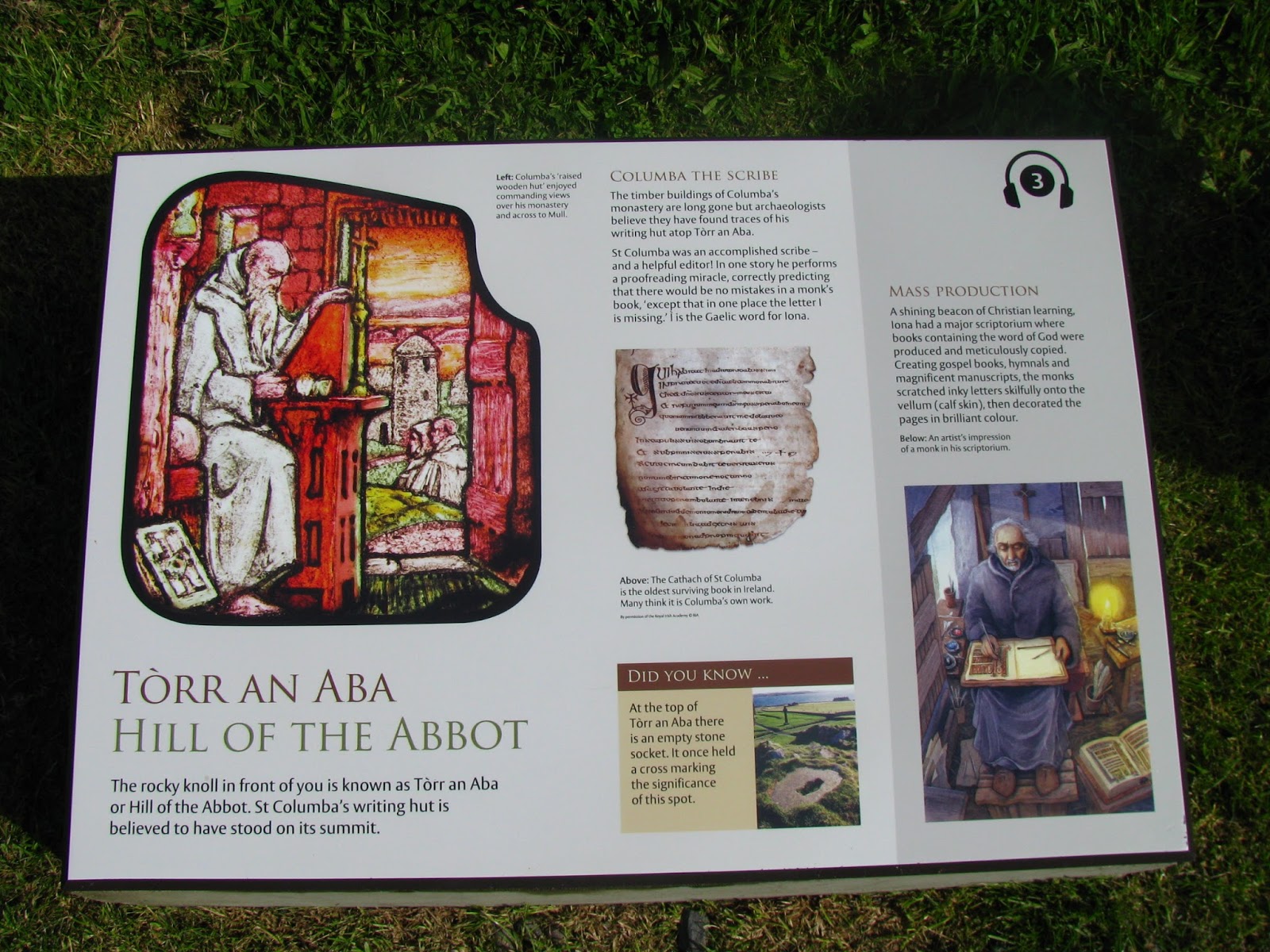
It is thought that St. Columba oversaw the work of his monastery community from a hut on this windy hill on Iona. He must have swept there a time or two-hundred-thousand, and in sweeping, daily cleared out the attitudes, habits, and patterns of thought that would have doomed his metamorphosis from exiled warrior to sweet abbot.

A rich interpretive sign at the foot of Columba's hill


Tuesday, October 27, 2015

Signs

And God said, Let there be lights in the firmament of the heaven to divide the day from the night; and let them be for signs, and for seasons, and for days, and years . . . Genesis 1:14


The musical score is full of signs. 

The note on the page requires a pretty complex bit of reading: 
its shape and coloration convey the duration of the sound while its location on the staff indicate the pitch to be performed.


And then we have an array of signs that indicate how to play a note or groups of notes.

These include:

articulations (how one note is connected or not connected to the next note)

phrases (which notes go together as a units)

dynamics (how loud or soft a note or group of notes should sound)

processes (changes in dynamics or pace over time).
  

What we lack is a sign for the specific purpose of delineating trajectory. 

All the other signs require interpretation so that we can understand the flow and direction of the music.

As Charles Rosen wrote in his book on the music of the Romantic generation, it is not enough to obey the signs. Interpretation - that is, our artistic duty - requires asking why those signs are there. Asking that question yields insight into the composer's strategy, insight into the composer's personal way of writing a sonata, a rondo, or whatever the form at hand is. 


In this way, we learn how the music is moving, and when we communicate that knowledge through our performances, the composer's personality and genius are heard and our listeners are moved, too.  


Sunday, October 25, 2015

"Your Important Self Esteem"

My father would have turned 86 yesterday. 
In his memory, I share the following bit of "self help" he wrote in the 1980s. 
I think we still need it.


Your Important Self Esteem
by Rev. Charles J. Hulin III

A very unfortunate trait of our day is that of persons being forced into situations in which they are made to contest, compete, and clash with others.  Always, someone loses and has the ego bruised. We need cooperation more than competition to build up and bind together the human race. Since we make others feel like "losers" or "lesser persons" or "less than persons" by this onslaught on their esteem, such persons are nullified, in a sense, so they have to try to assert the self again. This is often done through various "attention getters."


Some "attention getters" used to massage the ego in hopes of regaining a sense of personhood:

being rebellious                 "I reject you."

being bossy                        "I am leader."

being dishonest                  "I am sly."

being sensational               "I am unusual."

being boastful                    "I have accomplished."

being self-centered            "I am important."

being "martyred"               "I suffer."

being self-righteous           "I am good."

being perfectionistic          "I am flawless."

being boisterous                "I am here!"

being sullen                       "I am not impressed."


Your Self Esteem

Always keep in mind that your self esteem is not dependent on others! Never think less of your self based on the thoughts of others.

1. Acceptance of you as a person

You were neither created nor endowed by any man. You were created and endowed by your Maker; you came from Him and will return to Him! You are a person and most unique since no one has ever been just like you, and no one can change that!

2. Approval of your intentions

You need no one's approval for your hopes and dreams. Your hopes and dreams are just that - YOURS! We all are taught when babies to win approval, and to avoid disapproval, from our parents. Thus, we live for years doing just that! Now, however, you are a grown-up person - your own person - and the approval of others is not necessary; Others may not know enough to qualify for approving or disapproving in regards to your life.

3. Appreciation of your accomplishments

Your importance as a person does not depend on whether your efforts are appreciated. You do what you do because it is your desire and capability as a person to do so. Tell yourself that because it is true! Tell yourself that many times a day if necessary.


Results:

If you believe and practice these three above, you will find that, being independent of others regarding your worth and esteem, you will:

view others objectively

view no one as threatening

discover the great potential in your life to be a very real, strong, noble, loving person.


Saturday, October 03, 2015

Big Week, Part 3: Dream

Last Tuesday, between the faculty gala and the choral hall opening, I addressed our departmental recital gathering (the weekly meeting of all our music majors) along the following lines.

Dr. Ingle, our university's president, set the tone for this academic year with the word "dream," so I would like to consider this topic of dreams together as musicians.

During the summer, I visited with a couple of old friends - friends who trained to be professional musicians. As we are all reaching middle age, we reflected that, while we are working in music, the primary duties of our jobs are not the things we trained for. Yes, we spent hours and hours learning how to perform a musical phrase with elegance and healthy technique, but since then, we have also learned to tutor students, to write good e-mails, to manage budgets, etc..

This being paid for things you didn't exactly train for is actually the norm. (And, by the way, it is a good reason for pursuing a liberal arts education.) But more than being the norm, this emphasizes that music is ultimately a gift to humanity. Yes, we do have gifts for performing music, but we are also to give that music to others. My friends and I agreed that, whether we were working professionally in music or not, we would still be making music and giving that gift. We do not have to be paid money for it, although it's nice to be. Our real pay is in the giving of the gift, in being part of a design that brings blessing to the world.

We music faculty want gainful employment for our students after they have finished their degrees, and hopefully that work will be in music. But achieving employment, even in music, is not really our central desire for our students. If our students' dreams are simply to be employed as musicians, and they achieve that goal, what then? What do the remaining years of their lives look like? What propels them to keep achieving and what gives meaning to that work?

And so I turn to questions that I first heard proposed by my friend, Brother Stefan Waligur. (Stefan is a great composer and an equally great friend whose gifts for empathy and getting to the heart of a matter are profound.)

Br. Stefan asks:

What are you doing with your music?

Whom are you loving with your music?

When we consider what we hope to accomplish with our music-making, we Christians tend to turn first to worship. Some of us are called to explicit church ministry, but not all of us. Those who serve by supporting the worship of congregations would do well to dream of three types of prayer found in the Psalms. I will list and briefly discuss them below but they are explored nicely here.

1. What should be obvious to most of us, worship involves praise and thanksgiving.

2. A second facet of what the psalmist offers - and something we don't frequently provide our congregations in any significant measure - is the opportunity to lament. Much of the world lives in lamentable situations, situations in which Christ joined them on Good Friday, but more often than not, we are not willing to linger with them even though many of these brothers and sisters have no choice but to lead their entire lives essentially on the cross or in the tomb. For a very challenging word on this topic, see this writing by Dr. Miguel De La Torre.

3. A third spiritual orientation is played out in the Psalms and that is the calming and quieting of the soul as referenced in Psalm 131 and other places. These words suggest a mode of relating with God that moves beyond praise or requests, nourishing trust and inviting intimacy, instead.

There is music that expresses and catalyzes thanks, lament, and silence. This is music of the church that could make a difference for the world. And a great many of us are called to make music "out there" in secular space where the needs of the human heart are just as great. A number of powerful passages speak to the possibilities of music in that arena and help us know how to build our dreams.

Exodus 15 - Miriam's celebration
What do we celebrate as individuals and as a culture?
We should be on the lookout for what to celebrate so as to help others recognize its specialness and importance. Musicians have a strong voice in defining what and how to celebrate.

Exodus 31 - Moses' remembrance
Poised to enter the Promised Land, Moses reviewed and interpreted Israel's history for his nation.
What history do we need not to forget?
World War I, the Holocaust . . .
but good things, too -
the lives of saints, the legacies of those who shaped us and of those who answered God's call. 

Joshua 6 - Jericho's walls
What sorts of walls do we see that need to come down?
Joshua's story teaches something about the real labor of bringing down walls. And this is it: While the quick clip of the wall falling flashes across the broadcast news and captivates our imaginations, the real work of advocacy consists of untold days and years, even generations, of preparation. The advocate comes to recognize the need for change then works and works and works to raise consciousness, and then just keeps keeping at it until critical mass finally weighs heavily enough on the wall. Somewhere in all of this, music can be a megaphone for the powerless. 

I Samuel 16 - Saul's therapy
Who is troubled and can be relieved by our music-making?
When we reach out to bring relief through music, we enter into relationships, and, just as in David's case, those relationships might well determine the very course of our lives.

Acts 16 - The pastime of Paul and Silas
I picture it like this: at midnight, having been flogged, jailed, and put in stocks, Paul looks to Silas and says, "So what do we do now?" and Silas says, "Let's sing some of those hymns you like." And so they persisted in faith and in the holy pastime of private worship. And God responded. We who strive to make music professionally for others sometimes forget to make it in our homes and to express our heart to God with it, whatever the situation.

Ephesians 5 and Colossians 3
What needs to be taught or learned? Who needs to be encouraged and to what end?
Music plays a role in these things, too, and perhaps a greater role than the factors we normally think contribute to these dynamics.

In conclusion, I think of Brother Stefan again and of another of the probing questions God has given him.

As we go out from Southeastern to the places of our lives' service, do we truly believe God loves us?

So often, we focus so much on ideas of our sinfulness and God's justice that we never allow ourselves truly to accept that God loves us. The initial posture of the prayer Jesus taught us was that of a child speaking to a parent, not of a lawbreaker begging a judge. I believe we need to pray that way until we can give the gift of music with the purity and freedom the world needs.    

An open space and a little window through which one might dream