Tuesday, September 22, 2015

Big Week, Part 2: Choral Hall!

Toward the end of the week, we celebrated a major achievement for our department and the university: the building and opening of our first facility designed specifically for music. The space is a beautiful room for choral rehearsals and will also house jazz ensemble and string orchestra rehearsals for the next year or so. Another larger rehearsal room for wind ensemble and orchestra is scheduled to open in the fall of 2016.

Just before the public ribbon cutting, we held a brief event for donors in the space during which our dean, two students, and I spoke. Dr. Gordon also led Chamber Singers in Bruckner's "Locus iste" which was a perfect choice for the occasion.

My remarks ended up being about the legacy we have received and what should be the impact of that on the future. I shared those remarks a few days ago here. In the process of preparing those remarks, I found myself contemplating the contributions of the two men in the middle of organization who led us to this special day. Of course none of this could have been done without the vision of the university's administration or the gifts of donors, but as chair, I have special knowledge of the contributions of our former chair and our dean, Drs. Tindall and Collins, contributions which might be overlooked in the excitement of the event.

Dr. Tindall was brought to Southeastern as chair nearly thirty years ago. He built the department just about from scratch and committed his entire career to "building people" in our programs. He did so with humility through the constant change of these decades in American universities and in Christian higher education in particular. It has been his dream for years and years and years to move that solemn, people-building work into facilities worthy of the endeavor, and he has hung in there until this has finally started coming to pass. Without his service, dreams, and sacrifice - a great deal of which took place before the rest of us came to SEU - we would never have reached this milestone.

And from the dean's office, Dr. Collins has cogitated, advocated, and collaborated pretty much non-stop from his first day on the job to make this milestone a very fine one. He has considered every detail of the building and has masterfully consulted with everyone involved from the architect to the builders to the donors so that the facility would be of the highest quality. His passion and effort has been thorough-going and I simply cannot imagine anyone achieving this better than he has.We are blessed to have him spearheading such works in our midst.

Over, around, and through the work of these colleagues, there is a sense that the entire project is something much bigger than any of us, and this great synergy, spanning from our alumni to the impact of our programs on the distant future, seemed evident at the ribbon cutting. Even bigger than our collective imaginings and our best efforts at plans at the University, I dare say I believe we are finding ourselves within a movement of the Spirit. I hope this strengthens the faith of others as it has mine.  

Monday, September 21, 2015

Big Week, Part I: Faculty Gala


First Presbyterian, Lakeland
This week was a big week for all of us here in the Department of Music at Southeastern. It started with the first concert of our season, the faculty gala.

This time around, the gala was built around the concept music of the Americas and my colleagues provided works ranging from Canada to the Caribbean. I was particularly pleased by the variety of works spanning opera arias, chamber music (including a work for snare drum and computer), and jazz. A favorite aspect of this concert for me was being introduced to the music of Srul Irving Glick. I am copying the program and a few remarks shared during the gala at the end of this post.

I also enjoyed getting back into thinking about a canon of American keyboard works that could serve as an alternative to the traditional European canon that most of us continue to promulgate. I am not looking to displace that canon, but I am interested in providing a somewhat parallel set of experiences developed on our shores that raises awareness of how things have evolved here.

There are several points that are on my mind today regarding that alternative canon.  

1. It’s lacking in significant Baroque-era works. That should not come as a surprise as we didn’t get the country started quite early enough. Even after Bach and others were done writing in a heavily contrapuntal style in Europe, we were mostly just starting to get a bit of musical infrastructure in place. By the time that was a little bit up and running, early Classical music was on the scene. Some composers had come across the ocean with those new ideas while others already here were operating with older models suggesting a compositional mindset that almost had more in common with Medieval procedures than those of the Baroque or Classical periods.

At that time, Alexander Reinagle was writing in an early classical style informed by what was idiomatic on harpsichord and fortepiano. His dances and variations can provide a sense of airiness similar to what a Handel suite or Mozart variations might contribute to a European-based recital.

2. It seems that the early American repertoire is much more engaged with British material than the mainstream European music that has survived in the standard repertoire. While Scottish songs of Haydn or Beethoven are occasionally performed, the keyboardist playing early American music will be frequently confronted with sets of reels, variations on fiddle tunes, and references to British military triumphs.

3. As one moves toward the repertoire of the 20th century, Afro-Cuban influences become more and more important. Beginning with Gottschalk’s musical souvenirs of Havana and continuing with the crossover of those ideas into ragtime, Latin rhythms become a part of the fundamental vocabulary of music in the United States. In some ways, our music might be a whole lot better integrated than our nation.

  
Jefferson’s March - Alexander Reinagle (1756-1809)

The Willow Song - Douglas Moore (1893-1969)

Ricordanza - George Rochberg (1918-2005)

Stop Speaking - Andy Akiho (b. 1979) 
    
Intermission
                                                                                   
Caprice: Sui Moi! - Louis Moreau Gottschalk (1829-1869)
                                                                               
Monica’s Waltz - Gian Carlo Menotti (1911-2007)                                                                           
Suite Hebraique no. 6 - Srul Irving Glick (1934-2002)
        
St. Thomas - Sonny Rollins (b. 1930)


Who is an American? Where is an American? When is an American?


These three increasingly strange sounding questions remind us that the American experience differs significantly depending upon one’s culture, location, and moment in time. The music of this year’s faculty gala has been chosen to move us across such boundaries of geography, history, and ethnicity so as to hear, as it were, America singing.

We begin in the early days of the United States with a march composed for our third president. Then, Dr. Braamse will join me for an aria from the 1950s that is strongly suggestive of folk music, particularly British folk music which shaped the sound of American popular music in the 1800s. Our third work is described by its composer as a “commentary” on the opening passage of a Beethoven cello sonata and leads us to recollect the Germanic roots of American classical music.

------------

More and more, we find ourselves collaborating with machines. And these machines seem to be taking on a life of their own. But it is a life that we gave them. We are about to hear a work that explores that very relationship. A snare drum over there and a “digital storyteller” over here are going to have a conversation. That has always been the ideal of chamber music: a conversation. So the concept of this piece is tried and true, but some of the sounds are new and reflect the age of machines in which we are living.


At yesterday’s rehearsal, I checked the volume level with a decibel meter and I can assure you that what you are about hear will never be louder than 90 decibels and will generally not be much over 80 decibels. That means that the sounds bouncing around the room will not be much louder than a rather noisy car driving down the street. This performance will also rarely be significantly louder than it is at its beginning. I tell you that so can relax and not be worried that it will suddenly get much louder. However, the sounds will continue at a fairly intense level for a while. So those with hearing aids or those with sensitive ears who are sitting directly in front of the amplifier might want to make some little adjustments.

Mr. Blume is doing a great service by performing a work like this right here on our concert series. While this work might seem a bit abstract or odd to some of us, it is representative of the huge repertoire of electro-acoustic music that has been created since the advent of the tape recorder. And, like any work of art, “Stop Speaking” is open to a range of interpretations. So you should feel free to find it off-putting, or witty, or maybe even poignant.

------------

A New Orleans native, Louis Moreau Gottschalk, was the first American pianist to achieve acclaim in Europe. In addition to his time there, he went on numerous tours performing in the United States and in Latin America. His many experiences abroad are expressed in works like the one you just heard which combines a Chopin-like flare for the keyboard with the rhythms Gottschalk heard in the music of Cuba.

Now we turn to another aria from the mid-20th, century this time from Menotti’s The Medium. The character Monica is singing to, and on behalf of, a mute boy named Toby who works as a servant in her home. Monica is expressing their affection for each other. After this aria, Mrs. Gardiner and I will share a beautiful work by the prolific Canadian composer, Srul Glick who is well known for his contributions to concert music and to the Jewish liturgical repertoire.

------------

Our final selection this evening is a great example of sounds of music that journey through time and space to create a sense of identity in our hemisphere. The tune, St. Thomas, is thought to have its origins in an English tune that first appeared in print in the 1770s. Transplanted to the Caribbean, in was transformed into a nursery song. Finally, through the “interpretation” of Sonny Rollins it has become a jazz classic.

Thursday, September 17, 2015

"Excellence with Anointing"


I'm sharing my remarks from this morning's SEU Choral Hall ribbon cutting below for those who might be interested.


It is my honor and privilege to speak to you today on behalf of the music faculty.

We could not be more grateful or more deeply touched by the fact that our university’s administration and all of you generous donors have made this moment possible.  You should know that scores and scores of alumni, as well as faculty members who came before us, are rejoicing because they dreamed of this day, and they committed to our programs even though they had no hope of benefitting from the exquisite experience of learning and working in a wonderful space like this. 

They left us a legacy of “excellence with anointing.”[1] It is our joy to carry on that tradition much more fully equipped because of your giving. In this room, we will continue to train students for artistic distinction and we will provide them with paths to professional fulfillment.

But we will also challenge them with holy questions -

Questions like: “What are you doing with your music?” 

Questions like: “Who are you loving with your music?"[2]

So I feel confident in telling you that by building this facility you have invested in students who will make a difference in this world and the next.
 
Like Miriam in the desert, they will teach their peers what and how to celebrate.[3]

Like Moses on the banks of the Jordan, they will sing out the history that should not be forgotten.[4]

Like Joshua at Jericho, they will play down walls that need to fall. [5]

Like David with Saul, they will calm the souls of the troubled. [6]

And like Paul and Silas in the dungeon, they will worship and God will move.[7]

We know these students, and that is what they’re going to do.


[1] Dr. Danny Tindall
[2] Br. Stefan Waligur
[3] Exodus 15
[4] Deuteronomy 31
[5] Joshua 6
[6] I Samuel 16
[7] Acts 16

Sunday, September 13, 2015

Musical Gifts

All Saints' Episcopal Church, Lakeland

Recently, I had the privilege of playing my friend Stefan Waligur's song "Consider the Lilies" with a young friend at church. I was certain that the experience of this pure voice singing music that is so inviting to a sense of God's provision would be well worth the trip that morning and I thought of inviting friends on Facebook to join us for the service just to hear the song.

As the service unfolded, logistical details and various unknowns distracted us. The singing and the playing were okay, but they didn't rise to the level of specialness we had experienced in our rehearsals. And that's alright. I trust that what needed to be communicated was communicated.

That said, this occasion reminded me of two powerful truths.

1. The most meaningful moments of music making - the moments in which something breaks through to our souls and lets us know that some wonderfulness exists beyond our material lives - these moments often come in the practice room and the rehearsal space, not in the sanctuary or the concert hall with lots of listeners. This is an excellent reason to be involved in making music one's self!

2. If we supposedly mature musicians are feeling stressed or unfocused, we need intentionally to take time to provide what we are able to give the musicians around us: stability and a comfort zone, a platform for singing/playing into their potential. The same must be true of our teaching. By taking time and creating this space, we can grow the great "kin-dom" of peace which Jesus announced.


Saturday, August 15, 2015

Slither Forth!

As some readers might know, I have spent several years developing a faith-integrating class piano curriculum based on the stories of St. Columba. Like many callings and creative projects, this "pilgrim of practice" found me, not the other way around.

How?
Blooms in a bog on Iona's Dun I

A number of friends associated with Baptist Theological Seminary at Richmond and Grace Baptist Church (also located in Richmond, VA) shared their exposure to the renewal associated with the island of Iona where the Irish saint founded his monastery. Then, Kathy traveled to Iona, and as she traveled, I read about Scotland and was intrigued by the story of Columba and the monster of Ness. A few years passed during which I occasionally thought of writing a piano piece about the story. To commemorate the bicentennial of Liszt's birth, I finally wrote that solo piano "Columban Legend." Around that time, our adoptive son came to live with us. He had an interest in books and video games rooted in mythology and magic. I thought reading the stories of a saint like Columba might be a good faith-based connection point with him, so I ordered a copy of Adomnan's biography to share excerpts from time to time.  

One thing led to another and I started writing lots of little piano pieces. Last summer, Kathy and I traveled to a conference on Iona and that was a life-shaping experience. On that trip, I discovered the fun fact that the Robertson family has a historic association with Columba's community. This was a neat finding as my maternal grandmother was a Robertson.

With all this Columba-oriented engagement in my life, it stuck me that I have become involved in an informal Columban priesthood of sorts. I find myself interpreting my own Christian experience, and sometimes providing counsel, through my version of a Columban lens.

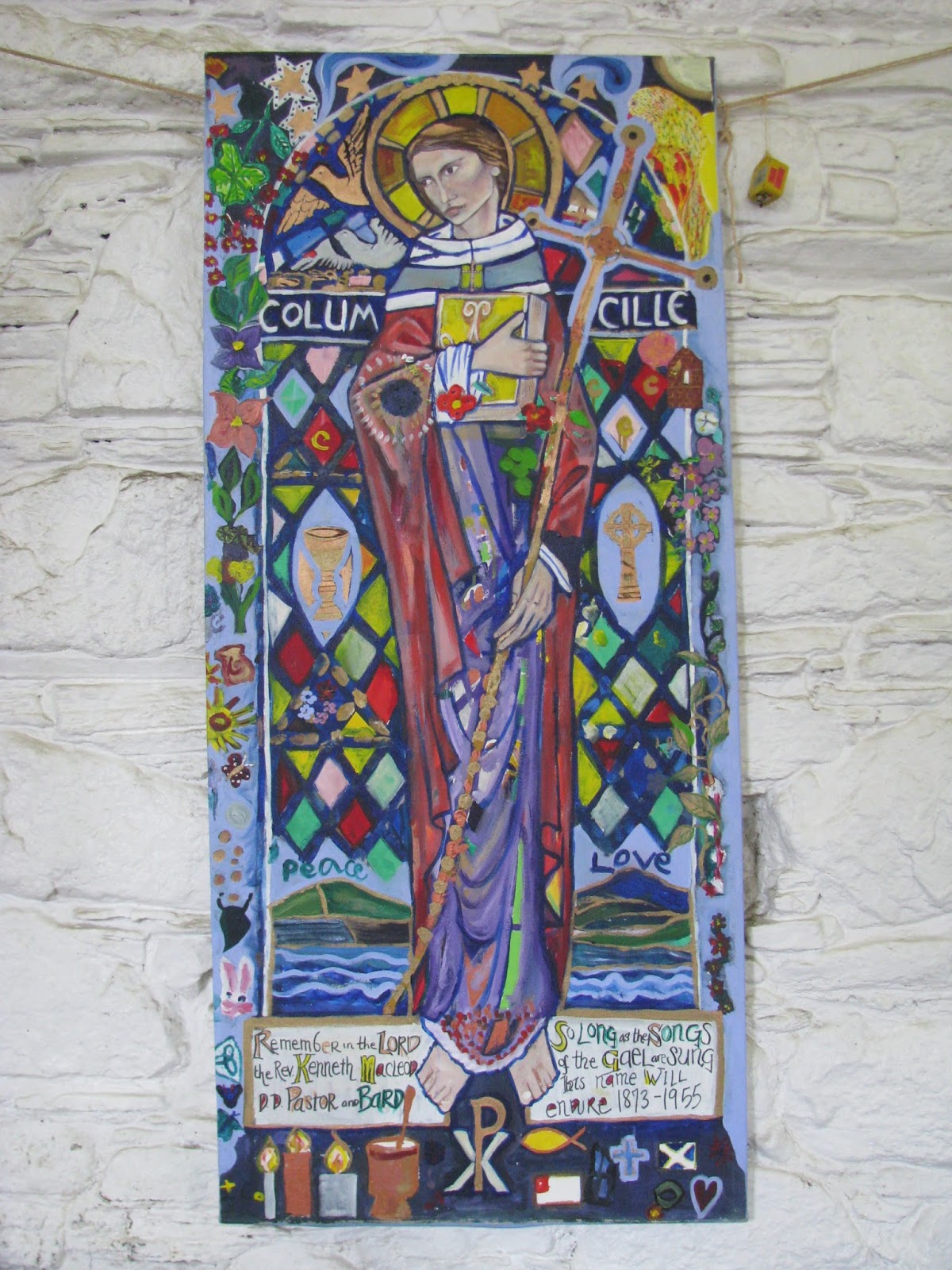
Image of Columba in the refectory at Iona Abbey
The Appeal of Columba
For those who aren't familiar with Columba, I offer the following brief explanation of my own interest.

There is a great deal in the life of Columba to intrigue a musician. He was a singer of penetrating sweetness and experienced something like glossolalic chanting on at least one occasion. He was also a composer and a compelling advocate for the class of bards when its very existence was at stake.

I am amazed by the number stories about Columba and I find that their details have potential for speaking to my own situations in a metaphorical fashion.

My Tradition
As a Baptist, my entrance into the Christian Faith was through an experience of being "born again." Jesus and Nicodemus had a discussion about that term in John 3. In the Baptist tradition, it has come to mean a moment of personal surrender through which Christ becomes both one's savior and lord. Something supernatural is believed to happen at this time, something that makes one's life new in the here and now.

From time to time, I long for a fresh deepening of this newness, and during a recent contemplative prayer gathering, that yearning returned. I found myself considering the little and big bits of obsessiveness and depressiveness and cynicism and sarcasm . . . in my life. I also thought on my experiences of wholesomeness and healing, beauty and peace. The result was that I wanted somehow to wallow before, but far below, God, and to slough off those essentially lifeless things, finally to rise up as a newer, better, truer me. I consider these desires, these impulses toward some spiritual movement, a blessing.


Slither Forth!
Snake-like forms on St. Martin's Cross

And then I found myself thinking of snakes.

Of course there's the serpent of Genesis who tempted us to estrangement from God, and there's the serpent lifted up in the wilderness for the healing of a wandering nation (also mentioned in John 3).

St. Patrick drove the snakes out of Ireland,
or so it is said. For his part,
Columba blessed the snakes of Iona,
rendering them harmless.

It is my understanding that there is a Celtic tradition that views snakes in a positive light, as symbols of rebirth, in fact. What more vivid image could there be for the throwing off of the old self than that of a snake shedding its skin?

The snake must move forward to bring this about. And once the process is begun, there is really no way of going back.

While effort is required of the snake to complete this moulting, it does not happen at the whim of the snake. It happens when the time is right. It happens when that old self can be left behind.

The snake discovers and reveals its new self through many movements ranging from full-body convulsions to the tiny actions of individual scales.

The snake travels on, belly to the ground registering the gritty grains of sand. Its eyes straining to make out forms through the thick blades of grass, it knows best by listening, by feeling the vibrations of its world.

Occasionally it lifts itself or climbs for vision and sustenance.

And so
we too
slither forth.


Tuesday, July 28, 2015

In the Field


I have just returned from the last trip of the summer and now I'm looking forward to the 2015-2016 academic year. For the first time, I am blogging from my cottage in our music village.

For those who might not know, this “music village” is the temporary home of Southeastern’s department of music. We expect to be camping out here for the next twelve months while new facilities are being built. Our little neighborhood consists of 18 cottages that house practice rooms, offices, and storage plus three music-specific modular units – a music office and computer music lab, a percussion studio, and a keyboard lab.

Back to the summer’s trips - they were excellent and involved a Christian summer music festival exploring the significance of diversity in Christian theology, a trip to New York with Kathy’s girls choir, and a great church music conference in New Orleans followed by a wedding deep in Cajun country. These journeys reminded me of the great big world that’s out there. They also challenged, inspired, energized, and focused me in new ways. That said, I believe the transformation that needs to happen within me will occur over the course of many days and weeks of hard work here in Cottage 16.

At the end of the school year, we moved from our old buildings (which no longer exist) to temporary structures in the field on the north end of campus. The process required that we look at every single item that had come to find a comfy, if crowded, home in the old facilities, and determine which things should be carried into the field with us. A number of things were left behind as they no longer served a purpose or were proving to be unnecessary weights as we moved forward. Now that we are in the village, there is more sorting to do.

Just as the physical move provided an occasion for this great house cleaning, I think our move into the village also provides an opportunity for each of us to undertake a more important spiritual inventory.

There are many good things we need to take into the village with us, but it is also an ideal time to consider what things we would like to leave behind. We might even find some treasures in this field that will enrich our lives together when we move into our new home next year.

I encourage everyone who will be spending time in the village to invite the Spirit to shine light on the things that might be good to leave behind. A list of several that have occurred to me might help with other folks' self-evaluations.

Lack of discipline in worship or prayer

Unwillingness to be shaped by the Spirit

The tendency to feed anxieties

Expectations built on old relationships

Attitudes that contribute to cliquishness and sarcasm
 

To some extent, the daily life of our department has been drawn out into the light of day because our village is now in this field. Most of our nearest neighbors have never lived this close to our community before. The logistics of the move and the rearrangement of where we are on campus have resulted in lots of folks meeting and interacting who had only heard of each other before.

I am hoping that more good things can come from this dynamic in the year ahead.  

I am imagining the worshipful sounds of hard work emanating from our village and lifting up those around us. I am dreaming that the activity of our neighborhood will convey not so much a sense of talents or giftedness but qualities of sweetness and listening. I am praying that we will become aware of the presence of God as we move through our narrow streets.


Wednesday, July 08, 2015

Glencairn


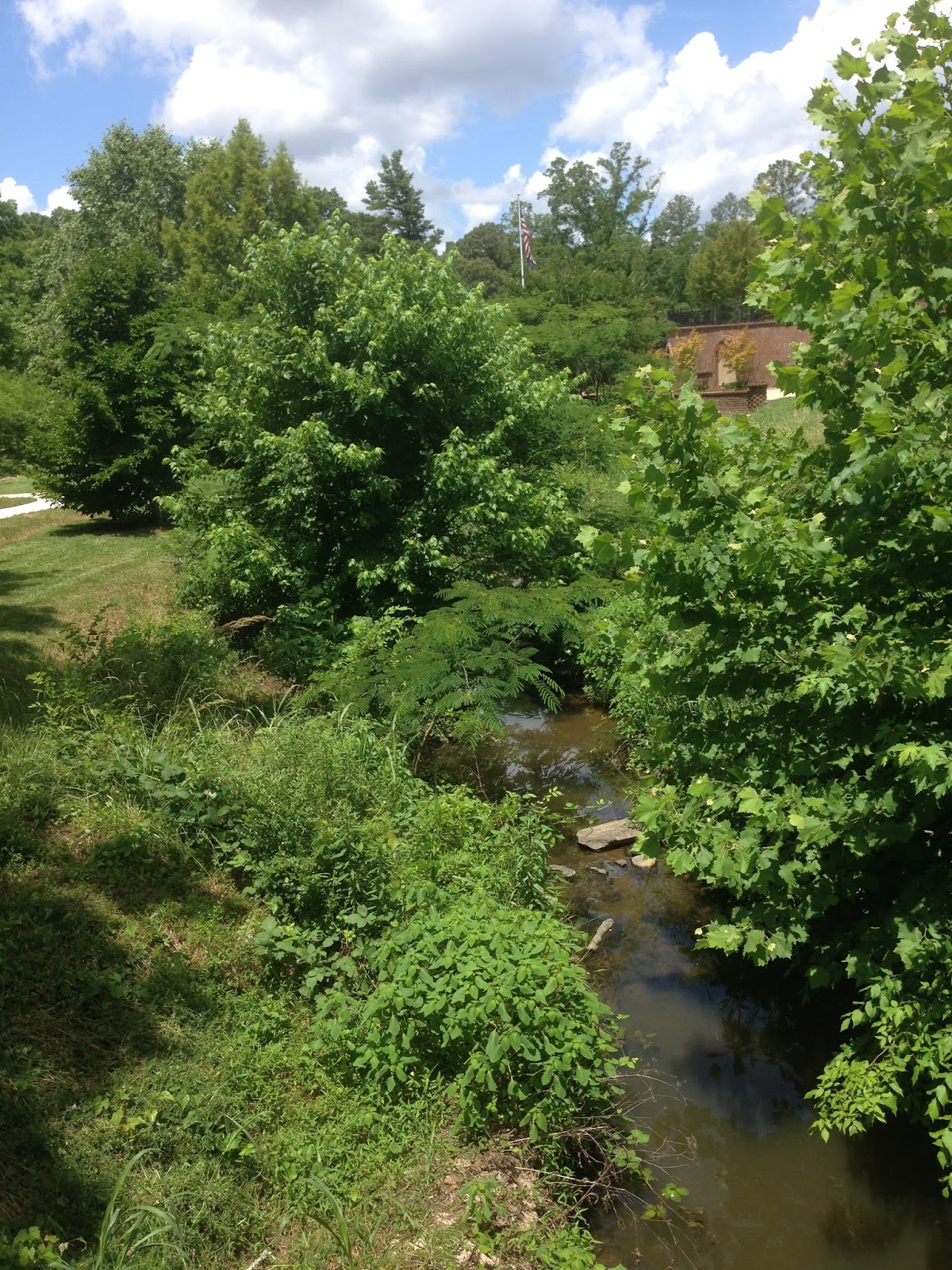
I've blogged before about the role Glencairn Gardens played in the formation of my aesthetics.

In June, I revisited this lovely spot and now I'm blogging what was the stream of consciousness at that time.


Stereo fountains and green-screened trails


solitary benches for pondering and prayer


hidden lawns where youngsters cuddle


and bridges for meetings real and imagined


A coming-of-age place


a garden for grown-ups, too -


strong willows and sunlit cypresses
where thrushes stir at midday


rich growth on rugged ground


plus color wheels and sundials
for the children we now raise


Carolina senses springing up


and stately re-restatements of timeless themes


A place for resting


and the flags under which we live


An aging veteran watches a hawk make circles
while a little ballerina echoes her mother's movements
posing for a picture they'll always have


Here are feelings of ancient places by the water

massive stones

unseen snakes

turtles cruising in bubbly streams

and untamed flora framing a creek-bed


I return to shady camellia paths


and see old borders open onto new vistas


Saturday, June 20, 2015

Broadway Classroom


Another highlight of our New York trip (It was pretty much all highlights!) was the group's Broadway Classroom experience. Members of the girls choir, parents, and chaperones all participated in an excellent crash course in Broadway performance culture presented by Brent Frederick, a very active music director-pianist-conductor, and Scott Mikita, a swing from the current Phantom cast. They led us through a portion of the number "Masquerade," ably teaching the music, the diction, the choreography, and holding a little mock audition. This was all really fun and I highly recommend it to other groups of musicians going to New York.

In case you're wondering, a swing is a performer with the capability and flexibility to perform various roles in a production depending upon who is ill on any given occasion. In Mr. Mikita's situation, this involves being prepared with music, text, choreography, and acting for the majority of the major male roles in Phantom eight times a week, and sometimes portions of multiple roles during the same performance. That's very, very impressive.

While we're considering what these gentlemen do for a living, I would encourage music students to take a look at Mr. Frederick's resume. I'm sure you'll notice the variety of musical work he has done from regional theater to a cruise ship show to Broadway. Also, notice his degree - music education! This should be enlightening to those who are concerned about what job their degree might lead to. This should also wake up some who are in a confused sleep and are dreaming that music ed people pursue their degrees because they can't make it in a more performance-based part of the music world. Lastly, be sure to read through the list of skills he shares to make himself more marketable. I've copied it below. These amount to keyboard skills, aural theory, and technology studies - the things you often wonder when you'll ever need them. I just happened to notice these this morning and thought I should point them out.

SPECIAL SKILLS
• Sight-reading, including audition accompanying for NYC casting directors and for Broadway shows.
• Transcribing by ear.
• Tech guru: Expert proficiency in Finale and Sibelius; synthesizer programming; digital audio workstations including Pro Tools, Digital Performer, Logic, and Ableton Live; orchestral mockups
  Now for what I've been wanting to share.


Mr. Frederick and Mr. Mikita presented a superb session that showed how all the fundamentals of creative work - the musical disciplines you learn in school - are the exact things you apply everyday in the professional world of music performance. Personally, it was affirming to hear the same messages I heard from my teachers - messages that I try to convey to my students - being promulgated by these artists in their part of the culture.


What are those messages?

1. Arts are multi-layered and the performing arts require that performers engage with the layers.

You learn notes, technique, diction, musicality, choreography, etc., and then, keep adding more and more layers to make the end result an awesome expression, something out of the ordinary.

2. Subtext, subtext, subtext.

You need to apply all the aspects of all those layers with reason. Whether you're playing notes or moving across the stage, there has to be something going through your mind, something stirring your emotions. Otherwise, the audience gets no charge. Singers do it. Choreographers do it . . . It's how you make your motivation a part of the work.

3. The audience gets it.

The audience doesn't have time to deconstruct and evaluate each and every little move. Hopefully, you've saturated everything with ideas through years of focus and months of rehearsal. That sustained effort, that care for the work, comes through, at the very least, on the subconscious level. That might work better for the experience of art, anyway.

4. Conductors and directors want to see that you can take direction.

Hopefully your brilliance will show up and show through at your audition, but if you can't be responsive to the ones with the vision for the show, that won't matter much. The more malleable you are, and the less room has to be made for your personality, the better. So, as Mr. Mikita put it, "Be game and it'll be fun."

5. Education that is both specific and well-rounded is key.

During the question and answer time at the end of our session, Mr. Mikita was asked about what a young person with an interest in a career in theater should be doing now. His answer? Do as much theater as you can. Live life - theater isn't about theater; it's about the world outside the theater. And go to college.

Finally, I would add that these two successful genetlemen were balanced, poised, and readily able to engage with their students and fellow human beings in a normal, healthy, positive way: not the warped stereotype of artists that's often promoted but the reality of disciplined professionals, whatever their field.

Thank you, sirs, for modelling musicianship, professionalism, good teaching, humility, and humanity for my young friends and me!


Thursday, June 18, 2015

Jazz at Lincoln Center


While in New York, Kathy and I visited one of America’s great art music temples – Frederick P. Rose Hall, home of the Jazz at Lincoln Center Orchestra. Sitting atop several floors of the Shops at Columbus Circle, the entrance to the venue is a lively place with a bit of the ambiance of a grand cinema. The occasion was the conclusion of a season exploring “how jazz has both integrated and influenced the rich musical traditions of the Caribbean and North, South, and Central America.” The performance was a tribute to Latin Jazz greats, Tito Puente and Machito, coordinated by bassist Carlos Henriquez.


At first blush, one saw that the three percussionists basically functioned as one organism, the saxophones sounded like a rank of organ pipes, and the persistent presence and miraculous nuance of the cowbell made it the soprano soloist of the group. Soon the trumpets started playing masterful improvisations.

As the evening went on, I started to recognize the many layers that made the experience so good. In  addition to all of the above, the instruments were simply played very, very well. Each musician's sound was rich, warm, brilliant, and distinctive. When combined, the instruments of the ensemble were also a marvel of sonority, blend, and coordination. Undergirding it all, professionalism was a given.

Then there was the excitement, imagination, and genius inspiration of the music itself - tremendous diversity joyfully combined in close-knit communities all across the stage. The mission statement of Jazz at Lincoln Center puts it like this:

We believe Jazz is a metaphor for Democracy. Because jazz is improvisational, it celebrates personal freedom and encourages individual expression. Because jazz is swinging, it dedicates that freedom to finding and maintaining common ground with others. Because jazz is rooted in the blues, it inspires us to face adversity with persistent optimism.

Education is also a core value of Jazz at Lincoln Center and the evening's performers were unabashed advocates for the continuation of their tradition. History was alive and onstage with them as they expressed the importance of doing our generation's duty of appreciating and handing on this heritage. That duty involves not just hearing, loving, and sharing the music, but also supporting the infrastructure necessary to keep it going - publications of scholarship, outreach programs, and the hall itself. A decade into its existence, it's already time to update the fantastic facility in which these fine musicians perform. 


Twelve plus hours after the concert, I was still feeling its rhythms. But on the night of, the audience's well developed patina of concert etiquette seemed to inhibit a visceral response to the stirring elements of this music rooted in ancient religions. A little dancing broke out at the end, but only after considerable cajoling from the stage.

Reflecting on the specialness of that evening and of the performers who made it possible, I realized more fully that charisma is not a way one acts but is an entrancing and involving thing that sometimes sneaks in unnoticed when one is very truly doing.


Monday, June 08, 2015

Morning Has Broken

Quite some time has passed since my last bit of blogging. Most of that time has been spent in activities concluding the school year. I believe things at school, at the Lasker Summer Music Festival, and with my life in general are in an interim period as we prepare for the dawning of a new era. Thus, it seems appropriate to blog today about experiences with the hymn known to many of us as "Morning Has Broken."

The tune name is BUNESSAN which is also the name of a little town on the Ross of Mull, a peninsula on the Scottish island of Mull. Kathy and I passed through the town on our way to Iona about this time last summer. Here's a picture I took somewhere around Bunessan.


As I recently shared with a friend, it seems to me that a lot of old tunes such as this one reflect the contour of the landscapes in which they came into being. The rapid but lyrical and airy rises and falls of BUNESSAN seem to fit well with the mountain vistas and sea scenes that one can view from the town.

We don't know exactly where the tune comes from, and the actual reason it is known as BUNESSAN is that it was first published with a text by Mary MacDonald (1789-1872), poet, Baptist, and wife to a crofter who lived and created her work near Bunessan. Here is the rich first verse of her famous text:

Child in the manger,
infant of Mary;
outcast and stranger,
Lord of all;
Child who inherits
all our transgressions,
all our demerits
on Him fall.

Many wonderful texts have since been paired with this great tune. Taking time to sing through the page scans on the Hymnary.org page for BUNESSAN can be a heart-warming devotional activity. In addition to the well-known "Morning Has Broken," you will also find a lovely wedding hymn, a powerful Trinitarian text by John Bell, and a version of St. Patrick's Breastplate.

Finally, I would like to share my own version which is what prompted all my thinking this weekend about BUNESSAN. 

During this summer's Lasker Summer Music Festival, I presented a recital and a talk exploring the goodness of diversity. The recital was a tour of works not included on the usual classical piano itinerary which consists mostly of German and Austrian journeys with occasional side-trips through France, Spain, and Russia. I've copied the program at the end of this post for the curious reader.

The second half of the recital was framed by works that reference the diversity of creation, not just the diversity of nations. (The first half was framed by works that reference various Americas that exist within the nation we call the United States.)

I wrote my arrangement of "Morning Has Broken" for an SEU student who, at the time, was a church music major. She has since gone on to be a missionary in Tanzania. BUNESSAN was a meaningful tune to her and her mother. In addition, she was studying the first prelude in Bach's Well-Tempered Clavier and was good at major scales. You can hear those influences in the arrangement. In addition, each section of the arrangement expresses a key phrase from one of the verses -

 "Blackbird has spoken like the first bird."

"Sweet the rain's new fall . . . like the first dewfall"
 
"Mine is the sunlight!"

The photos posted with the performance are from Pentecost morning in Lasker. It was on this visit to Lasker that I realized that, similar to Iona, Lasker is a "home for music pilgrims."


Lasker Summer Music Festival 2015
Lasker Baptist Church
July 22, 2015      7:30 P.M.
Charles Hulin, piano
Kathy Hulin, horn           Greg Parker, baritone

Jefferson’s March                                                       Alexander Reinagle
Rapsodia Negra                                                               Ernesto Lecuona
Live, Laugh, Love                                                               Charles Hulin
Allqamari Kanki!                                                                Quechua Song
Tango Finale                                                                      Astor Piazzolla
Ghost Dance of the Zuñis                                                    Carlos Troyer
 Intermission
Morning Has Broken                                                    Arr. Charles Hulin
Gamelan                                                                      Leopold Godowsky
The Law and the Prophets                                            Han song, adapted
Adventures of an African Boy                                     Margaret Goldston
         Theme
         Along the Zambesi River  
         Meeting a Chimpanzee
         Dancing with a Friend      
         A Rest under the Baobob Tree
         A Stroll through Waving Elephant Grass     
         Racing with a Giraffe
         A Tribal Ceremony
Graceful Ghost Rag                                                           William Bolcom
All Creatures of Our God and King                            Arr. Richard Walters